From Landscape to Network: What the Connections Reveal
Part 2 of Mapping the Regenerative Agriculture Ecosystem
Where Part 1 Left Off
The first phase of this work produced something the regenerative agriculture space largely lacks: a structured, searchable landscape of more than 3,000 organizations spanning farms, investors, brands, and technology companies across the United States. That database answered a basic but consequential question: who exists?
The second phase asked a harder one: how are they connected, and what does the shape of those connections tell us?
Building the Network
To move from landscape to network, I mapped the membership relationships between organizations and the multi-stakeholder coalitions that have become a defining structural feature of the regenerative agriculture space. Coalitions like the Regenerative Organic Alliance, the LEAF Coalition, and the Sustainable Food Policy Alliance don’t just convene organizations: they create edges. Shared membership is a proxy for shared agenda, and in aggregate those memberships reveal the underlying architecture of the ecosystem.
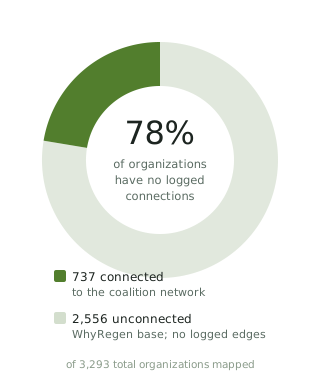
The result was a network of 737 connected organizations, anchored by 13 coalition hubs, embedded within the broader 3,000-plus organization landscape. The anonymized version of that map is below.
Anonymized hub-and-spoke network. Organization names replaced with role-based labels. Click any node to explore connections.
What the Structure Shows
The network is a hub-and-spoke system. Thirteen coalitions act as the connective tissue of the ecosystem, and organizations relate to the broader network through membership in one of them. This has real implications: the coalitions aren’t just convening bodies, they are the infrastructure. Remove them and the network fragments significantly.
A few findings stood out.
Coalition membership is the primary connector. The organizations with the most structural influence in this network are not necessarily the largest or most well-known. They are the ones that belong to multiple coalitions simultaneously. Cross-coalition membership is rare, which means the organizations that span more than one hub become disproportionately important as bridges between communities that would otherwise have no path between them.
Certain sectors are structurally isolated from each other. The apparel and fiber cluster, organized around regenerative fiber sourcing, sits largely disconnected from the food system cluster. Despite shared commitments to regenerative land management, these communities have few shared memberships and limited structural overlap. That gap represents both a coordination failure and an opportunity: a well-positioned intermediary organization or shared certification framework could close it.
The largest players are not always the most structurally important. Conventional market logic would suggest that the biggest brands or most-capitalized investors are the most influential actors. Network logic often disagrees. Structural influence is a function of position, not size, and some mid-sized organizations occupy bridging positions that give them outsized leverage in how information, capital, and relationships flow through the ecosystem.
Most of the landscape remains unconnected. The 737-node connected component is embedded in a landscape of 3,000-plus organizations, the majority of which have no logged connections to anyone else. This isn’t a failure of the database. It reflects the actual state of the ecosystem: a large share of farms, regional investors, and emerging technology companies operate without public formal ties to the coalitions and networks that structure the space at scale.
Not all structural hubs are coalitions. The coalition hub model captures most of the ecosystem’s structural architecture, but the network data surfaces a second pattern worth naming. A small number of non-coalition actors — companies that function as measurement platforms, finance vehicles, or implementing partners rather than convening bodies — appear to accumulate structural centrality through repeated bilateral partnerships rather than through shared membership. Where a coalition aggregates members around a shared agenda, these actors aggregate customers around a shared technical function. The network effect is similar: organizations that independently need the same tool end up connected through the same node, even without a membership structure to formalize the relationship. This suggests that structural influence in an ecosystem like this one can emerge from functional indispensability as well as from convening, and that the distinction between coalition hubs and platform hubs is worth tracking as the network matures.
Zooming In: Three Views from Inside the Network
The full hub-and-spoke map tells the ecosystem’s structural story at altitude. But one of the more practical things a network like this enables is the ability to zoom in on individual hubs and examine their internal logic: who belongs, how they connect to adjacent communities, and where the gaps are.
Three sub-maps illustrate what that looks like in practice.
The Funder Network
Impact finance cluster. Solid edges indicate coalition membership; dashed edges indicate documented co-investment relationships.
The funder network centers on the impact finance cluster identified in the full map. A single coalition hub anchors the view, with member organizations distributed around it: foundations, investment vehicles, asset managers, and corporate giving programs. What the sub-map surfaces that the full map obscures is the co-investment layer. Documented bilateral deals, distinguished here by dashed edges, reveal a secondary network of capital relationships that exist independent of shared coalition membership. Some organizations are connected to the hub through membership and to each other through co-investment, making them doubly embedded. Others appear only through one type of edge, signaling a more transactional or arm’s-length relationship. The distinction matters for anyone trying to understand how capital actually moves through this cluster versus how it is formally organized.
The Certification Brand Ecosystem
Certification brand ecosystem. Hub connects to three adjacent coalitions via dashed edges; brand nodes colored by category.
The certification brand ecosystem zooms in on the largest hub in the full network: the coalition anchoring regenerative organic certification, with its licensed brand membership mapped by category (food and wellness brands, fiber and apparel brands, and farms and wineries). The dashed edges connecting this hub to three adjacent coalitions show where brand memberships overlap. The brands that appear in multiple coalitions are the cross-coalition connectors identified in the structural analysis, visible here in their actual relational context. A small number of brands span three coalitions independently. That pattern is rare and consequential: it identifies the organizations doing the most active work to integrate across the ecosystem’s otherwise siloed communities.
The Supply Chain
Supply chain map. Retailers at top, farms and verification bodies at bottom. Solid edges are formal partnerships; dashed edges indicate co-membership or indirect relationships.
The supply chain map takes a different cross-section entirely, organized not by coalition membership but by position in a vertical market structure. Retailers sit at the top; farms, verification bodies, and NGOs toward the bottom; CPG brands and commodity traders in the middle. The layered layout makes visible something the radial hub-and-spoke view does not: the distance between retail commitments and farm-level practice. Some retailers connect directly to farms or verification bodies through multiple edges. Others connect only through large CPG intermediaries, with no direct relationship to the production end of the supply chain. In a field where greenwashing risk is concentrated at exactly that distance, the supply chain map is where structural analysis starts to have commercial and reputational stakes.
Taken together, these three sub-maps demonstrate what becomes possible once a landscape database generates a connected network: the ability to move between levels of resolution, from the full ecosystem architecture down to the specific relational logic of any given hub, cluster, or supply chain. Each zoom reveals something the others cannot. And each raises new questions that only surveyed, validated data would be able to answer.
The Limits of Observed Data
The network built here is derived entirely from publicly observable information: coalition membership lists, published partnerships, and organizational disclosures. That is a meaningful starting point, but it captures only a fraction of the relationships that actually shape how the ecosystem functions.
The most consequential connections in any ecosystem are often the ones that don’t appear in press releases. Informal mentorships between farmers. Capital relationships that predate formal fund announcements. Technical assistance agreements between NGOs and producers that never make it onto a coalition membership page. Buyer-supplier relationships built through word of mouth rather than certification.
To build a map that is genuinely accurate rather than just structurally plausible, surveyed data is essential. Direct outreach to organizations, asking them to self-report their key relationships, funders, customers, and collaborators, would surface the connections that secondary research cannot. It would also introduce a layer of ground-truth validation: an organization that appears isolated in the observed network may in fact be deeply embedded in regional relationships that simply aren’t indexed anywhere publicly.
The current network is a hypothesis about the ecosystem’s structure. Survey data would begin to confirm or revise it.
From Map to Strategy
Ecosystem maps become useful when they inform decisions. A few implications that follow directly from the network analysis:
For investors and funders, the most underleveraged opportunity may not be in the connected core but at the edges, where regional farms and emerging technology companies sit outside the coalition structure entirely and have no current path into the networks that move capital.
For brands and buyers, cross-coalition membership is a signal worth tracking. The brands that span multiple coalitions are building durable ecosystem relationships rather than single-standard compliance. They are also the most visible nodes in the network, making them easier to identify as potential partners, customers, or collaborators.
For intermediary organizations like Why Regenerative, the structural gap between the fiber and apparel world and the food system world points to a concrete activation opportunity. ROC already spans both communities as a shared certification standard, but the brands holding ROC certification on the food side and those holding it on the fiber side have limited structural overlap and few shared relationships. A cross-sector brand cohort convening ROC-certified food and fiber brands around shared supply chain development, co-marketing, or advocacy would activate the connections that a shared standard implies but hasn’t yet produced.
What Comes Next
This network reflects coalition memberships as of early 2026. It is a snapshot built from what is publicly observable, which means it is incomplete by definition.
The next phase of this work is to make sure we are looking at it accurately in the first place. That means investing in primary data collection: surveying organizations directly, validating relationships, and surfacing the informal and regional connections that secondary research leaves invisible.
Once the map is accurate, it becomes something worth maintaining. And a maintained, validated ecosystem map, updated over time as coalitions shift, capital flows, and actors enter and exit the space, becomes something the regenerative agriculture field currently doesn’t have: a living picture of how the system actually holds together.