<?xml version="1.0" encoding="utf-8"?><feed xmlns="http://www.w3.org/2005/Atom" ><generator uri="https://jekyllrb.com/" version="3.10.0">Jekyll</generator><link href="https://mollyhydorn.github.io/feed.xml" rel="self" type="application/atom+xml" /><link href="https://mollyhydorn.github.io/" rel="alternate" type="text/html" /><updated>2026-04-28T02:57:52+00:00</updated><id>https://mollyhydorn.github.io/feed.xml</id><title type="html">Molly Hydorn, Ph.D.</title><subtitle>Ecosystem mapping and partnership development in regenerative agriculture.</subtitle><entry><title type="html">From Landscape to Network: What the Connections Reveal</title><link href="https://mollyhydorn.github.io/network-map-case-study-part-2/" rel="alternate" type="text/html" title="From Landscape to Network: What the Connections Reveal" /><published>2026-04-19T00:00:00+00:00</published><updated>2026-04-19T00:00:00+00:00</updated><id>https://mollyhydorn.github.io/regen-network-case-study-part-2</id><content type="html" xml:base="https://mollyhydorn.github.io/network-map-case-study-part-2/"><![CDATA[<p><em>Part 2 of Mapping the Regenerative Agriculture Ecosystem</em></p>

<hr />

<h3 id="where-part-1-left-off">Where Part 1 Left Off</h3>

<p>The first phase of this work produced something the regenerative agriculture space largely lacks: a structured, searchable landscape of more than 3,000 organizations spanning farms, investors, brands, and technology companies across the United States. That database answered a basic but consequential question: who exists?</p>

<p>The second phase asked a harder one: how are they connected, and what does the shape of those connections tell us?</p>

<hr />

<h3 id="building-the-network">Building the Network</h3>

<p>To move from landscape to network, I mapped the membership relationships between organizations and the multi-stakeholder coalitions that have become a defining structural feature of the regenerative agriculture space. Coalitions like the Regenerative Organic Alliance, the LEAF Coalition, and the Sustainable Food Policy Alliance don’t just convene organizations: they create edges. Shared membership is a proxy for shared agenda, and in aggregate those memberships reveal the underlying architecture of the ecosystem.</p>

<p>The result was a network of 737 connected organizations, anchored by 13 coalition hubs, embedded within the broader 3,000-plus organization landscape. The anonymized version of that map is below.</p>

<div style="margin: 32px 0; border: 1px solid #e0ddd4; border-radius: 4px; overflow: hidden;">
  <iframe src="/assets/regen_ag_hub_spoke_anonymized.html" width="100%" height="600" frameborder="0" style="display:block;" title="Anonymized Regenerative Agriculture Hub-and-Spoke Network Map">
  </iframe>
</div>
<p style="font-size: 13px; color: #888; margin-top: -16px;">Anonymized hub-and-spoke network. Organization names replaced with role-based labels. Click any node to explore connections.</p>

<hr />

<h3 id="what-the-structure-shows">What the Structure Shows</h3>

<p>The network is a hub-and-spoke system. Thirteen coalitions act as the connective tissue of the ecosystem, and organizations relate to the broader network through membership in one of them. This has real implications: the coalitions aren’t just convening bodies, they are the infrastructure. Remove them and the network fragments significantly.</p>

<p>A few findings stood out.</p>

<p><strong>Coalition membership is the primary connector.</strong> The organizations with the most structural influence in this network are not necessarily the largest or most well-known. They are the ones that belong to multiple coalitions simultaneously. Cross-coalition membership is rare, which means the organizations that span more than one hub become disproportionately important as bridges between communities that would otherwise have no path between them.</p>

<p><strong>Certain sectors are structurally isolated from each other.</strong> The apparel and fiber cluster, organized around regenerative fiber sourcing, sits largely disconnected from the food system cluster. Despite shared commitments to regenerative land management, these communities have few shared memberships and limited structural overlap. That gap represents both a coordination failure and an opportunity: a well-positioned intermediary organization or shared certification framework could close it.</p>

<p><strong>The largest players are not always the most structurally important.</strong> Conventional market logic would suggest that the biggest brands or most-capitalized investors are the most influential actors. Network logic often disagrees. Structural influence is a function of position, not size, and some mid-sized organizations occupy bridging positions that give them outsized leverage in how information, capital, and relationships flow through the ecosystem.</p>

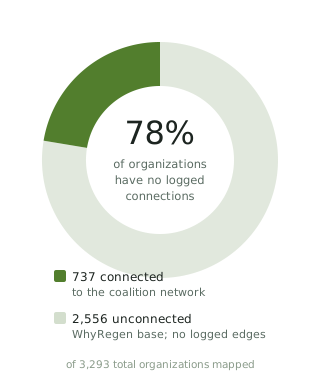
<p><strong>Most of the landscape remains unconnected.</strong> The 737-node connected component is embedded in a landscape of 3,000-plus organizations, the majority of which have no logged connections to anyone else. This isn’t a failure of the database. It reflects the actual state of the ecosystem: a large share of farms, regional investors, and emerging technology companies operate without public formal ties to the coalitions and networks that structure the space at scale.</p>
<figure style="margin: 32px 0;">
  <img src="/assets/connectivity-donut.svg" alt="78% of mapped organizations have no logged network connections" style="max-width: 500px; width: 100%;" />
  <figcaption style="font-size: 13px; color: #888; margin-top: 8px;">Of 3,293 organizations in the landscape database, only 737 have logged connections to the coalition network.</figcaption>
</figure>

<p><strong>Not all structural hubs are coalitions.</strong> The coalition hub model captures most of the ecosystem’s structural architecture, but the network data surfaces a second pattern worth naming. A small number of non-coalition actors — companies that function as measurement platforms, finance vehicles, or implementing partners rather than convening bodies — appear to accumulate structural centrality through repeated bilateral partnerships rather than through shared membership. Where a coalition aggregates members around a shared agenda, these actors aggregate customers around a shared technical function. The network effect is similar: organizations that independently need the same tool end up connected through the same node, even without a membership structure to formalize the relationship. This suggests that structural influence in an ecosystem like this one can emerge from functional indispensability as well as from convening, and that the distinction between coalition hubs and platform hubs is worth tracking as the network matures.</p>

<hr />

<h3 id="zooming-in-three-views-from-inside-the-network">Zooming In: Three Views from Inside the Network</h3>

<p>The full hub-and-spoke map tells the ecosystem’s structural story at altitude. But one of the more practical things a network like this enables is the ability to zoom in on individual hubs and examine their internal logic: who belongs, how they connect to adjacent communities, and where the gaps are.</p>

<p>Three sub-maps illustrate what that looks like in practice.</p>

<p><strong>The Funder Network</strong></p>

<div style="margin: 32px 0; border: 1px solid #e0ddd4; border-radius: 4px; overflow: hidden;">
  <iframe src="/assets/regen-funder-network-anon.html" width="100%" height="580" frameborder="0" style="display:block;" title="Anonymized Regenerative Agriculture Funder Network">
  </iframe>
</div>
<p style="font-size: 13px; color: #888; margin-top: -16px;">Impact finance cluster. Solid edges indicate coalition membership; dashed edges indicate documented co-investment relationships.</p>

<p>The funder network centers on the impact finance cluster identified in the full map. A single coalition hub anchors the view, with member organizations distributed around it: foundations, investment vehicles, asset managers, and corporate giving programs. What the sub-map surfaces that the full map obscures is the co-investment layer. Documented bilateral deals, distinguished here by dashed edges, reveal a secondary network of capital relationships that exist independent of shared coalition membership. Some organizations are connected to the hub through membership and to each other through co-investment, making them doubly embedded. Others appear only through one type of edge, signaling a more transactional or arm’s-length relationship. The distinction matters for anyone trying to understand how capital actually moves through this cluster versus how it is formally organized.</p>

<p><strong>The Certification Brand Ecosystem</strong></p>

<div style="margin: 32px 0; border: 1px solid #e0ddd4; border-radius: 4px; overflow: hidden;">
  <iframe src="/assets/regen-roa-brand-ecosystem-anon.html" width="100%" height="580" frameborder="0" style="display:block;" title="Anonymized ROA Brand Ecosystem Network">
  </iframe>
</div>
<p style="font-size: 13px; color: #888; margin-top: -16px;">Certification brand ecosystem. Hub connects to three adjacent coalitions via dashed edges; brand nodes colored by category.</p>

<p>The certification brand ecosystem zooms in on the largest hub in the full network: the coalition anchoring regenerative organic certification, with its licensed brand membership mapped by category (food and wellness brands, fiber and apparel brands, and farms and wineries). The dashed edges connecting this hub to three adjacent coalitions show where brand memberships overlap. The brands that appear in multiple coalitions are the cross-coalition connectors identified in the structural analysis, visible here in their actual relational context. A small number of brands span three coalitions independently. That pattern is rare and consequential: it identifies the organizations doing the most active work to integrate across the ecosystem’s otherwise siloed communities.</p>

<p><strong>The Supply Chain</strong></p>

<div style="margin: 32px 0; border: 1px solid #e0ddd4; border-radius: 4px; overflow: hidden;">
  <iframe src="/assets/regen-supply-chain-anon.html" width="100%" height="580" frameborder="0" style="display:block;" title="Anonymized Regenerative Agriculture Supply Chain Network">
  </iframe>
</div>
<p style="font-size: 13px; color: #888; margin-top: -16px;">Supply chain map. Retailers at top, farms and verification bodies at bottom. Solid edges are formal partnerships; dashed edges indicate co-membership or indirect relationships.</p>

<p>The supply chain map takes a different cross-section entirely, organized not by coalition membership but by position in a vertical market structure. Retailers sit at the top; farms, verification bodies, and NGOs toward the bottom; CPG brands and commodity traders in the middle. The layered layout makes visible something the radial hub-and-spoke view does not: the distance between retail commitments and farm-level practice. Some retailers connect directly to farms or verification bodies through multiple edges. Others connect only through large CPG intermediaries, with no direct relationship to the production end of the supply chain. In a field where greenwashing risk is concentrated at exactly that distance, the supply chain map is where structural analysis starts to have commercial and reputational stakes.</p>

<p>Taken together, these three sub-maps demonstrate what becomes possible once a landscape database generates a connected network: the ability to move between levels of resolution, from the full ecosystem architecture down to the specific relational logic of any given hub, cluster, or supply chain. Each zoom reveals something the others cannot. And each raises new questions that only surveyed, validated data would be able to answer.</p>

<hr />

<h3 id="the-limits-of-observed-data">The Limits of Observed Data</h3>

<p>The network built here is derived entirely from publicly observable information: coalition membership lists, published partnerships, and organizational disclosures. That is a meaningful starting point, but it captures only a fraction of the relationships that actually shape how the ecosystem functions.</p>

<p>The most consequential connections in any ecosystem are often the ones that don’t appear in press releases. Informal mentorships between farmers. Capital relationships that predate formal fund announcements. Technical assistance agreements between NGOs and producers that never make it onto a coalition membership page. Buyer-supplier relationships built through word of mouth rather than certification.</p>

<p>To build a map that is genuinely accurate rather than just structurally plausible, surveyed data is essential. Direct outreach to organizations, asking them to self-report their key relationships, funders, customers, and collaborators, would surface the connections that secondary research cannot. It would also introduce a layer of ground-truth validation: an organization that appears isolated in the observed network may in fact be deeply embedded in regional relationships that simply aren’t indexed anywhere publicly.</p>

<p>The current network is a hypothesis about the ecosystem’s structure. Survey data would begin to confirm or revise it.</p>

<hr />

<h3 id="from-map-to-strategy">From Map to Strategy</h3>

<p>Ecosystem maps become useful when they inform decisions. A few implications that follow directly from the network analysis:</p>

<p>For <strong>investors and funders</strong>, the most underleveraged opportunity may not be in the connected core but at the edges, where regional farms and emerging technology companies sit outside the coalition structure entirely and have no current path into the networks that move capital.</p>

<p>For <strong>brands and buyers</strong>, cross-coalition membership is a signal worth tracking. The brands that span multiple coalitions are building durable ecosystem relationships rather than single-standard compliance. They are also the most visible nodes in the network, making them easier to identify as potential partners, customers, or collaborators.</p>

<p>For <strong>intermediary organizations</strong> like Why Regenerative, the structural gap between the fiber and apparel world and the food system world points to a concrete activation opportunity. ROC already spans both communities as a shared certification standard, but the brands holding ROC certification on the food side and those holding it on the fiber side have limited structural overlap and few shared relationships. A cross-sector brand cohort convening ROC-certified food and fiber brands around shared supply chain development, co-marketing, or advocacy would activate the connections that a shared standard implies but hasn’t yet produced.</p>

<hr />

<h3 id="what-comes-next">What Comes Next</h3>

<p>This network reflects coalition memberships as of early 2026. It is a snapshot built from what is publicly observable, which means it is incomplete by definition.</p>

<p>The next phase of this work is to make sure we are looking at it accurately in the first place. That means investing in primary data collection: surveying organizations directly, validating relationships, and surfacing the informal and regional connections that secondary research leaves invisible.</p>

<p>Once the map is accurate, it becomes something worth maintaining. And a maintained, validated ecosystem map, updated over time as coalitions shift, capital flows, and actors enter and exit the space, becomes something the regenerative agriculture field currently doesn’t have: a living picture of how the system actually holds together.</p>]]></content><author><name></name></author><category term="work" /><summary type="html"><![CDATA[Part 2 of Mapping the Regenerative Agriculture Ecosystem]]></summary></entry><entry><title type="html">Mapping the Regenerative Agriculture Ecosystem: From Landscape to Network</title><link href="https://mollyhydorn.github.io/landscape-map-case-study/" rel="alternate" type="text/html" title="Mapping the Regenerative Agriculture Ecosystem: From Landscape to Network" /><published>2026-04-12T00:00:00+00:00</published><updated>2026-04-12T00:00:00+00:00</updated><id>https://mollyhydorn.github.io/regen-ecosystem-case-study</id><content type="html" xml:base="https://mollyhydorn.github.io/landscape-map-case-study/"><![CDATA[<h3 id="the-problem">The Problem</h3>

<p>Regenerative agriculture is growing faster than the infrastructure around it. New certifying bodies, investment vehicles, technology platforms, and consumer brands are entering the space each year, but the ecosystem remains deeply fragmented, poorly indexed, and difficult to navigate even for organizations working inside it. There is no authoritative directory. There is no shared map.</p>

<p>For organizations trying to build partnerships, deploy capital, or develop supply chains in this space, that opacity has real costs. Outreach is duplicative. Relationships are formed by proximity and chance rather than strategic fit. Opportunities for collaboration go unrealized because the relevant actors simply don’t know each other exists.</p>

<p>This project began with a straightforward premise: before you can build the ecosystem, you have to be able to see it.</p>

<hr />

<h3 id="what-i-built">What I Built</h3>

<p>Over the course of my work at Why Regenerative, I developed a structured landscape database of more than 3,000 organizations operating in or adjacent to the regenerative agriculture ecosystem in the United States. The database spans four sectors: farms and producers (2,459), investors and funders (151), brands and buyers (231), and technology companies (75).</p>

<p>Each record was researched and enriched manually, with organization descriptions, web links, geographic data, product categories, certification status, fundraising stage, and fund type where applicable. The goal was not just a list, but a usable intelligence asset: something that could support outreach prioritization, partnership identification, event programming, and strategic planning.</p>

<hr />

<h3 id="methodology">Methodology</h3>

<p>This landscape map was built using two primary sourcing approaches, each suited to a different segment of the ecosystem.</p>

<p>For farms and brands, I drew directly from the registries of active certifying organizations, including Regenerative Organic Certified (ROC), Regenified, the American Grassfed Association, Savory’s Ecological Outcome Verification program, and the Real Organic Project. Registry-based sourcing produces high-confidence records within a defined scope. This method captures the certified universe comprehensively, but says nothing about the much larger population of farms operating regeneratively without formal verification.</p>

<p>To reach that broader population, as well as investors and technology companies, I used LinkedIn keyword search filtered by organization type. Searching “regenerative agriculture” and restricting results to farms, financial institutions, and technology companies respectively produced a large initial universe that I then reviewed and enriched manually.</p>

<p>This approach has real coverage limitations worth naming. LinkedIn search systematically underrepresents smaller operations, rural producers, and organizations that don’t maintain an active digital presence. It captures self-identification with the regenerative label, not verified practice, meaning some organizations in the database use the language without the underlying methodology, and others doing substantive work may not use the term at all. Investor coverage is similarly incomplete: family offices, foundations, and funds active in the space but not self-describing as “regenerative agriculture” investors are likely underrepresented.</p>

<p>These limitations don’t undermine the map. They define its scope. What this database captures well is the organized, visible layer of the regenerative agriculture ecosystem. What it does not yet capture are the informal relationships between these actors, the uncredentialed farms that may represent the majority of regenerative production in practice, and the conventional capital beginning to move toward this space without yet adopting its language.</p>

<p>One methodological choice is worth making explicit. The database intentionally includes organizations that use “regenerative” language without holding a formal certification because restricting the map to certified actors only would produce a cleaner but less honest picture of the ecosystem. The self-identified regenerative universe is the relevant one for understanding how the term is actually functioning in the market, including at its contested edges. That inclusivity is not an endorsement of every claim in the database. It is a recognition that mapping the full landscape, certified and uncertified alike, is a prerequisite for understanding where the definitional boundaries are, how they are being drawn, and by whom.</p>

<hr />

<h3 id="what-the-data-shows">What the Data Shows</h3>

<p>Five findings stand out from the landscape data.</p>

<p><em>The ecosystem is vast but largely uncredentialed.</em> Only 11.5% of mapped farms hold a recognized certification. The remaining 88.5% operate without third-party verification, a structural gap that limits access to premium markets, carbon programs, and mission-aligned capital. This figure likely understates the true scale of the uncredentialed universe, given that certified farms are better represented in the sourcing methodology.</p>

<p><em>Regenerative agriculture, in practice, is predominantly livestock.</em> Beef appears in over 61% of farm product listings. When combined with chicken, pork, eggs, lamb, and dairy, animal products dominate the landscape. This reflects the historical alignment between holistic grazing and the regenerative label, and points to a relative underrepresentation of row crops, perennial systems, and plant-based production.</p>

<p><em>Production is distributed; capital is not.</em> Farm activity is spread across the country, led by Texas, California, Pennsylvania, and New York. Investor headquarters cluster tightly in Colorado, New York, and California, a geographic mismatch between where regenerative production happens and where the capital to support it is based.</p>

<p><em>The capital stack has meaningful gaps.</em> Venture and impact funds dominate the investor landscape at 47 and 37 organizations respectively. Credit and lending vehicles number just 11, a significant gap given that most farm-level transitions require patient debt, not equity. The infrastructure for financing the actual practice change on the ground remains thin.</p>

<p><em>Brand certification reflects a contested definition.</em> ROC accounts for 61% of brand certifications, followed by Rainforest Alliance (20%) and Regenified (17%). These are philosophically distinct standards with different verification requirements and different theories of what regenerative agriculture demands. ROC integrates soil health, animal welfare, and worker equity as a unified standard; Rainforest Alliance emphasizes supply chain sustainability and biodiversity; Regenified focuses on measurable soil outcomes. Their co-presence under the same label is not incidental. <a href="https://grocerynerd.substack.com/p/grocery-update-145-the-fight-over" target="_blank" rel="noopener noreferrer">As industry veteran Alan Lewis has documented</a>, this is precisely the mechanism through which meaningful claims get diluted: when one term is used to mean many different things, the connection between claim and practice becomes harder for buyers, retailers, and consumers to verify. A landscape map that shows three distinct certification frameworks operating under a single marketing category is not just a taxonomic observation. It is a picture of a definitional contest that has real consequences for producers who have invested in rigorous standards and for consumers who are paying a premium on the assumption that those standards mean something.</p>

<p>The charts below are the same interactive views as the standalone data page: certification mix, geography, products, investors, brand standards, and technology stage.</p>

<!-- EMBED DATA VISUALIZATIONS -->
<div style="margin: 32px 0; border: 1px solid #e0ddd4; border-radius: 4px; overflow: hidden;">
  <iframe src="/assets/regen-data-viz.html" width="100%" height="3600" frameborder="0" style="display:block;" title="Regenerative agriculture landscape data visualizations">
  </iframe>
</div>
<p style="font-size: 13px; color: #888; margin-top: -16px;">
  Charts built from the landscape database. Scroll inside the frame to see all sections, or
  <a href="/assets/regen-data-viz.html" target="_blank">open full screen →</a>
</p>

<hr />

<h3 id="from-landscape-to-network">From Landscape to Network</h3>

<p>What this database establishes is a roster, a structured, sourced account of who is operating in the regenerative agriculture ecosystem and in what capacity. That is not a small thing. In a space this fragmented, knowing who exists and how to categorize them is a prerequisite for almost everything else: partnership development, capital deployment, market building, policy advocacy. A landscape map is where serious ecosystem work begins.</p>

<p>But it is not where it ends.</p>

<p>The more valuable and more difficult layer of analysis is the network underneath the landscape, not just who the actors are, but how they are connected. Which certified farms have established buyer relationships, and which are producing into a market vacuum? Which investors are co-investing, and which are operating in isolation from the rest of the capital stack? Which technology companies have achieved integration with farm operations at scale, and which remain disconnected from the producers they’re designed to serve?</p>

<p>The map below illustrates what that network layer could look like: 30 illustrative organizations across six sectors, connected by the kinds of relationships the landscape database does not yet capture. Click any node to explore its connections.</p>

<!-- EMBED NETWORK MAP -->
<div style="margin: 32px 0; border: 1px solid #e0ddd4; border-radius: 4px; overflow: hidden;">
  <iframe src="/assets/regen-ecosystem-map.html" width="100%" height="560" frameborder="0" style="display:block;" title="Regenerative Agriculture Ecosystem Map">
  </iframe>
</div>
<p style="font-size: 13px; color: #888; margin-top: -16px;">
  Illustrative network map. Organization names and relationships are fictional representations of ecosystem actor types.
  <a href="/assets/regen-ecosystem-map.html" target="_blank">Open full screen →</a>
</p>

<p>Network mapping in a fragmented ecosystem like this one is methodologically harder than landscape mapping. Relationships are not always public, not always stable, and not always legible from the outside. But the methods exist: co-appearance at industry events is a reliable proxy for professional proximity; co-investment data surfaces financial relationships between funds and companies; structured surveys of ecosystem participants can capture the informal referral and collaboration networks that don’t show up in any registry.</p>

<p>The reason this matters goes beyond academic interest. In a transition-stage ecosystem, network position determines outcomes. A farm that is well-connected to a certifying body, a mission-aligned buyer, and a patient lender is on a fundamentally different trajectory than an equally committed farm that has none of those relationships. Identifying which organizations sit at structural bridges, connecting otherwise isolated clusters, and which are doing important work in isolation is the kind of analysis that can actually direct resources, partnerships, and attention more effectively.</p>

<p>A network map would also make visible something that a landscape map cannot: the difference between certification and market integration. One of the structural concerns Lewis and others have raised about the proliferation of regenerative claims is that certification alone does not guarantee that a farm’s practices are actually connected to a market willing to reward them. A certified farm with no buyer relationship, no access to mission-aligned capital, and no connection to a retailer enforcing claim integrity is in a fundamentally different position than the label alone suggests. Network mapping is where that distinction becomes legible. Identifying which certified producers have downstream relationships with brands, retailers, and investors, and which are doing rigorous work in effective isolation, is the kind of analysis that could help direct resources, partnerships, and shelf space toward the claims that are most defensible, and away from the ones that are not.</p>

<p>This project is designed to evolve in that direction. The landscape database is the foundation. The network is the next layer. <a href="/network-map-case-study-part-2/">Continue to Part 2: What the Connections Reveal →</a></p>]]></content><author><name></name></author><category term="work" /><summary type="html"><![CDATA[The Problem]]></summary></entry></feed>